Click here to download the pdf version of this case study.
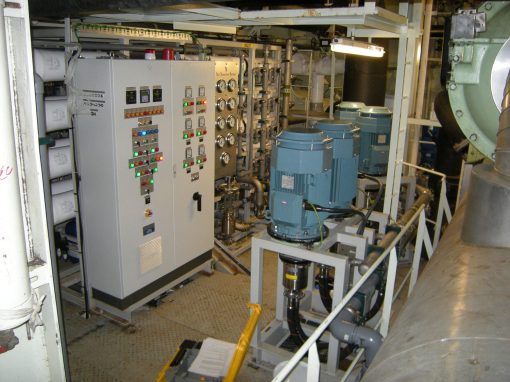
Salt Separation Services was approached by a leading cruise operator to retrofit the vessel’s existing potable water plant, replacing the ageing reverse osmosis (RO) system during a scheduled drydock period, delivering a modular RO retrofit solution.
The existing desalination plant had reached the end of its operational life and no longer met the operator’s expectations in terms of efficiency, reliability, lifecycle cost and output (the existing plant was 400 m³/d). The customer required a modern seawater reverse osmosis (SWRO) solution capable of delivering improved energy performance while ensuring a reliable supply of potable water for both passengers and crew, whilst maximising the output within the same engineering space on the ship.
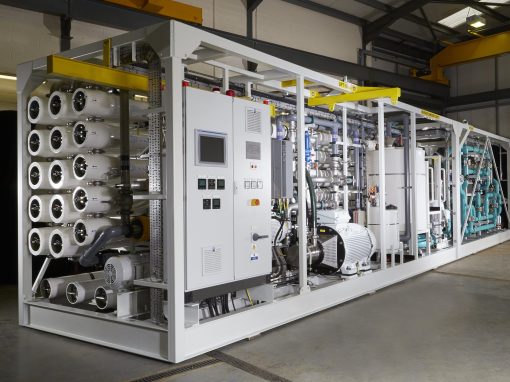
As with many retrofit projects on operational vessels, the new system had to be carefully engineered to fit within the vessel’s existing machinery spaces and restrictive installation routes. To address this challenge, we developed a high-capacity, modular SWRO system, designed to simplify transportation, installation and integration within the vessel during the limited drydock window.
The result was a 700 m³/d modular desalination plant capable of delivering reliable, energy-efficient potable water production while minimising installation complexity.
The Retrofit Challenge
Retrofitting major process equipment on an operational cruise vessel presents several unique challenges.
The replacement plant needed to be installed within an existing machinery space with limited available footprint, while also allowing components to pass through narrow access routes and restricted installation paths within the vessel.

In addition, the installation needed to be completed during the vessel’s scheduled drydock period, meaning the design had to support rapid installation and commissioning to avoid delays to the vessel’s return to service.
The cruise operator also placed strong emphasis on energy efficiency and passenger comfort. Desalination plants operate continuously on cruise ships, making energy consumption a major operational cost. At the same time, noise and vibration levels had to be carefully controlled to ensure that the desalination equipment did not impact passenger areas or sensitive onboard systems.
These requirements demanded a solution that combined compact modular design, high efficiency and low vibration operation, while maintaining the reliability required for continuous freshwater production at sea.
A Modular Desalination Solution
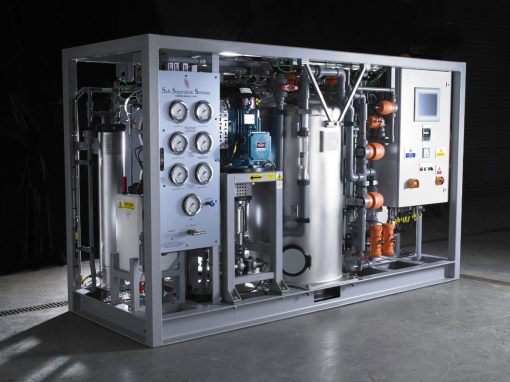
We designed, manufactured and supplied a 700 m³/d seawater RO plant, capable of producing 29.2 m³/h of potable water from seawater with a salinity of up to 36,000 mg/l total dissolved solids.
To overcome the installation constraints of the vessel, the system was engineered using a modular skid-based design. Each module was designed to be transported individually through the vessel’s restricted access routes before being assembled within the machinery space.

To ensure the system could be installed within the vessel’s existing infrastructure, all skid modules were specifically designed to pass through a restricted access aperture measuring 2.5m high by 2.5m wide, with a maximum equipment length of 5m.
This modular approach significantly simplified installation during the drydock period, reducing both installation time and risk while allowing the system to be integrated within the existing plant layout.
Once assembled, the system operates as a fully integrated desalination plant capable of producing potable water with a total dissolved solids content of less than 500 mg/l (1,000 μS/cm), ensuring a reliable freshwater supply for passengers and crew.
The plant is designed to operate across a seawater temperature range of 5°C to 32°C, with a heat exchanger used to pre-heat the feedwater when temperatures fall below 5°C to maintain consistent performance.
The RO membranes are arranged in a single-pass configuration, operating at a maximum recovery rate of 45%. This ensures sufficient reject flow to flush concentrated salts from the system, helping to reduce the risk of scaling and membrane fouling.
Effective Pretreatment for Reliable Operation
To maximise system performance and extend membrane life, the seawater feed undergoes a carefully designed pretreatment process prior to entering the RO membranes.
Raw seawater may contain suspended solids, colloidal material and dissolved salts with scaling potential. Without effective pretreatment, these contaminants can cause membrane fouling and reduce system efficiency.
The pretreatment system for this installation includes:
- Media filtration to remove suspended solids and particulate matter
- Antiscalant dosing to inhibit scaling caused by sparingly soluble salts
- Cartridge filtration to provide final polishing before the RO membranes
This multi-stage conditioning process protects the RO membranes and ensures long-term operational reliability.
Reducing Energy Consumption with Advanced Energy Recovery
Energy efficiency was a key priority for the cruise operator due to the continuous operation of desalination systems onboard.
Conventional seawater RO systems without energy recovery can consume more than 7.5 kWh of energy per cubic metre of water produced. To significantly reduce this operational demand, the system incorporates a Danfoss iSave isobaric energy recovery device.
The device captures hydraulic energy from the high-pressure reject stream and transfers it directly to the incoming feedwater. This process significantly reduces the power required from the high-pressure pump, lowering overall energy consumption by up to 40%, achieving energy usage to less than 3.5 kWh per cubic metre of water produced.
The system is powered by a high-pressure axial piston pump capable of delivering 30.2 m³/h at pressures of up to 80 barg, driven by a 100 kW motor.
An integrated booster pump, driven by a 12.2 kW motor and controlled via a Variable Frequency Drive (VFD), compensates for pressure losses across the RO membranes and maintains stable system operation.
Managing Noise & Vibration in a Modular RO Retrofit
Passenger comfort is a critical consideration on cruise vessels, particularly when installing high-pressure desalination equipment.
High-pressure pumps can generate significant mechanical vibration during operation, which can transmit through the vessel structure if not properly managed.
To address this, the system incorporates a silencer on the high-pressure pump assembly, reducing vibration generated by the pump pistons and minimising noise transmission within the machinery space.
This ensures the desalination system operates efficiently without affecting passenger comfort or onboard operations.
Delivering Reliable Onboard Water Production

The completed system provides the vessel with a high-capacity, energy-efficient freshwater production solution, capable of generating 700 m³/d of potable water from seawater.
Through the use of modular design, advanced energy recovery technology and robust pretreatment, the retrofit project delivered a desalination system that is both operationally efficient and straightforward to install within existing vessel infrastructure.
The modular approach not only simplified installation during the drydock period but also provides long-term benefits for maintenance access and future system upgrades.
The result is a modern, efficient and reliable desalination plant, supporting the vessel’s freshwater requirements while reducing operational energy consumption and lifecycle costs.


Customer Testimonial

“Working with Salt Separation Services Ltd has been a pleasure. They truly know their craft. The installation of our RO Plant went smoothly, and the commissioning was handled with great professionalism – all manuals and documentation were provided exactly as needed.
Since the plant has been in operation, their team has remained incredibly attentive. Whenever we reach out with a request or a technical issue, they respond quickly with practical solutions rather than problems.
They are a dedicated team that stands behind their product, and their willingness to help at every stage has been invaluable to our operations.”
If you’re looking to optimise your onboard water systems, SaltSep can deliver tailored solutions to meet your vessel’s specific potable water requirements. Click here to find out more.