Click here to view the PDF version of this case study.
Nelson Platform, North Sea
Providing reliable potable water offshore is critical for the safe operation of oil and gas platforms. When the existing potable water maker on the Nelson Platform, operated by Shell UK Ltd, began experiencing persistent leaks due to ageing pipework and corrosion, a full replacement solution was required.
Located in the Central and Northern North Sea, the Nelson platform requires a dependable source of potable water to support offshore personnel and operations. Rather than continuing to repair the ageing system in a piecemeal fashion, Shell opted to install a modern Reverse Osmosis (RO) potable water maker built with more corrosion-resistant materials and improved reliability.

Following a competitive tender evaluation process, Salt Separation Services was selected to design, manufacture, install and commission a replacement potable water maker package with a production capacity of 60 m³/d. The contract, valued at approximately £1.2 million, was awarded in December 2013.

A Modular System Designed for Offshore Installation
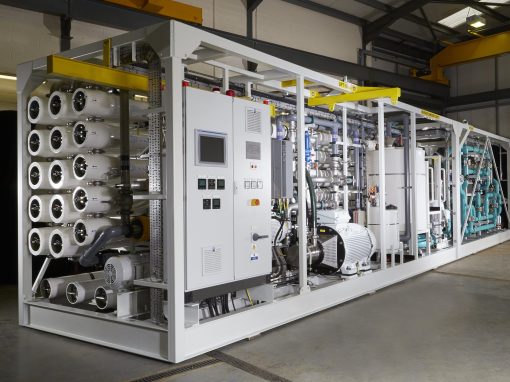
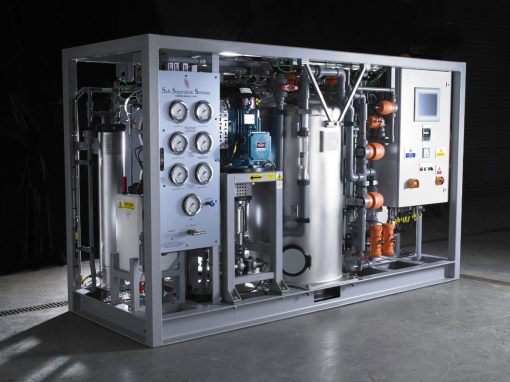
Offshore installations present unique logistical challenges, particularly when transporting and installing equipment in confined platform spaces. To overcome these constraints, we designed the system as a modular RO package, allowing the plant to be transported and installed in smaller sections.
The complete potable water maker was therefore engineered as multiple skid-mounted modules, which could be safely transported offshore and then interconnected both mechanically and electrically once installed on the platform.
To minimise risk during offshore installation, a full-scale installation mimic was constructed at our Rochdale manufacturing facility. This allowed all modules to be assembled exactly as they would be offshore, enabling complete factory testing and validation prior to shipment. This approach significantly reduced installation time and complexity during the offshore phase of the project.
Reverse Osmosis System Built to Shell Engineering Standards
The potable water system was designed and manufactured in accordance with Shell DEP (Design Engineering Practices) and ES (Engineering Standards), using components from approved manufacturers listed within Shell’s TAMAP database where applicable.
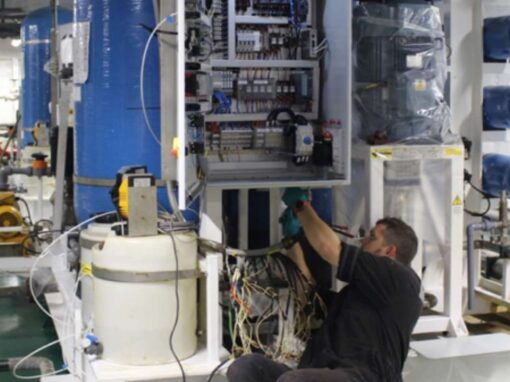
All fabrication work was completed at our Rochdale manufacturing facility, including carbon steel, stainless steel, and super duplex stainless steel pipework and structural components. Our welding personnel and procedures were fully qualified to meet Shell’s strict engineering requirements.
Prior to delivery, the system underwent a comprehensive Factory Acceptance Test (FAT) witnessed by the client to verify operational performance, system integrity, and compliance with project specifications.
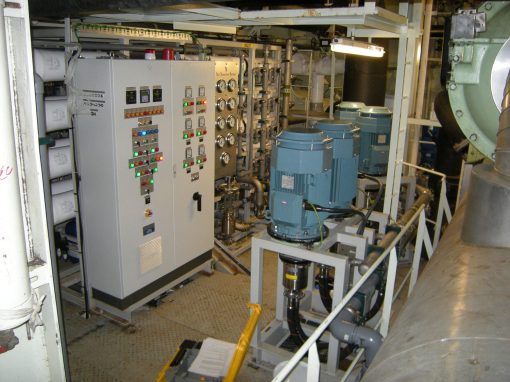
Operators monitor and control the system through a touchscreen Human Machine Interface (HMI) which displays real-time operating parameters, system performance data, and plant status information.
This high level of automation ensures efficient plant operation while reducing the requirement for manual oversight.
Highly Automated Offshore Water Production
The RO plant was designed to operate with minimal operator intervention, ensuring reliable water production in an offshore environment where engineering resources are limited.
The system features fully automatic plant operation, including:
- Automated start-up and shutdown
- Sand filter backwashing
- Carbon filter backwashing
- Automatic 24-hour reverse osmosis membrane flushing
Operators monitor and control the system through a touchscreen Human Machine Interface (HMI) which displays real-time operating parameters, system performance data, and plant status information.
This high level of automation ensures efficient plant operation while reducing the requirement for manual oversight.

Simplified Membrane Management for Offshore Reliability
To reduce system footprint and simplify maintenance offshore, the plant was intentionally designed without a traditional RO membrane cleaning system.
Instead, the RO membranes are treated as consumable components, with replacement typically carried out every 6 to 12 months. This approach provides several operational advantages:
- Reduced package size and piping complexity
- Elimination of hazardous cleaning chemicals offshore
- No chemical handling or disposal requirements
- Increased operational uptime for the RO plant
To support this strategy, the RO membrane array was designed to operate at a lower flux rate, extending membrane life and ensuring stable performance. The system also incorporates side-ported RO pressure vessels, enabling faster and more efficient membrane replacement during maintenance periods.
Rapid Commissioning and Reliable Operation
Once manufacturing and testing was completed, the modular system was transported offshore where our engineers carried out installation and commissioning on the Nelson platform.
Thanks to the extensive factory testing and modular installation approach, the system was successfully commissioned and produced potable-quality water within one hour of start-up.
The project demonstrates how modular reverse osmosis systems can provide reliable, efficient potable water production for offshore environments, while simplifying installation and long-term maintenance.